

Perception Management Through Perspective in Art (and Everyday Life)
- Marjolein Coppens
- Sep 27, 2025
- 3 min read

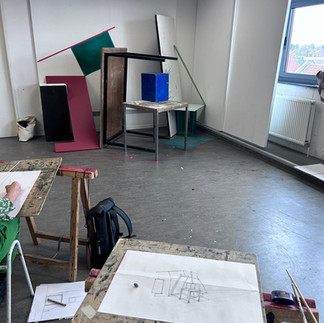
The first few weeks at the art academy in Arendonk have flown by as quickly as the three minute sketching exercises. As autumn arrives, I've decided to update my website. This season of change feels like the ideal moment to turn inwards and reflect and share my artistic endeavors. The first three weeks of panting classes at "Gemeentelijke Academie voor Schone Kunsten Arendonk" focused on Form and Perspective. For me this illuminated the intricate relationship between perspective, perception management and illusion. These explorations in perspective made me think about how our three-dimensional world gets translated onto a flat surface and what techniques artists can utilize to make this happen. It also resonated with me on another level. How human interaction is shaped by perception management.
![Kandinsky, V. (1908). Herbst in Bayern (Automne en Bavière) [Oil on paper collé on cardboard; 33 × 44.7 cm]. Musée national d’art moderne, Centre Pompidou.](https://static.wixstatic.com/media/6c9234_a5bd06188c354891b99db82f52512b15~mv2.png/v1/fill/w_980,h_725,al_c,q_90,usm_0.66_1.00_0.01,enc_avif,quality_auto/6c9234_a5bd06188c354891b99db82f52512b15~mv2.png)
Perspective is more than a technical skill. It's a way of interpreting the world. Artists have historically struggled with the depiction of three-dimensional space onto a two-dimensional surface. Techniques like linear perspective allow for realistic representations of depth, guiding viewers' eyes and suggesting and creating immersive experiences. During the Renaissance, artists such as Leonardo da Vinci and Raphael perfected linear perspective, utilizing vanishing points to create convincing spatial illusions. Da Vinci, for instance, applied these techniques in works like "The Last Supper," which features meticulously placed vanishing points that draw the viewer’s attention toward the focal point of Christ. This approach relies on our understanding of geometry and spatial relationships, making it a conscious form of perception management.

One insight that stands out for me is that perspective is, at its core, a form of perception management through math or geometry. It is not an absolute truth but more of a shared agreement, similar to mathematics. Painters are confined to flat planes, yet they can suggest depth using lines of different lengths and angles. Techniques like vanishing points and shadows help create the illusion of space, while warm and cool colors can create a sense of distance or closeness. Atmospheric perspective with less saturated and bluer colors comes to mind: a deeper blue can suggest a faraway mountain, while a warm yellow may bring a nearby field to life.
An artist who brilliantly explored the concepts of perspective is M.C. Escher. Through his work, he created visual paradoxes and impossible spaces that challenge how we view reality. His pieces encourage us to see the world from unconventional perspectives. This line of thought also brings to mind the concept of a tesseract or hypercube, a shape that exists in multiple dimensions but defies our standard understanding of space, much like some of Escher's work. At this year's Bridges MathArt conference, I learned that my alma mater was in the posession of an Esscher!

Just as artists manipulate perspective to influence our viewing experience, we also engage in perception management daily. Our understanding of the world is colored by our experiences, beliefs, and information consumption. Moreover, how we present ourselves also serves as a form of perception management. From our clothing choices, (body)language, we (un)consciously convey messages about who we are and how we want others to perceive us or how we express our narrative or identity.

On my recent trip to Elahuizen, I paused to look at the sailing boats floating by and the and at that moment, I could suddenly visualize the scenery as a painting. The expansive Frisian landscape beautifully supports this perspective shift, illustrating how the vastness of endless fields clearly marks the horizon or 'eye level'. We experience the horizon and eye level as a continuous 'line'.
After just a few days of classes, my perspective already started to shift. I began noticing lines and angles everywhere. I decided to document these small revelations and changes in perspective, giving me a chance to reflect on my artistic process by the end of the year. As an educator myself this should not come as a surprise, but it is fascinating how education can (re)shape our perceptions. By learning to see the world through different lenses, we enrich our experiences and foster deeper understanding of ourselves and one another.








Comments